Mags: InsideOut Turns 10!

Glossy Talk: InsideOut Turns 10

"Inside Out launched in April 2000, a home-grown Australian title with an eye for beauty and a brain for practicality," writes editorial director Karen McCartney in the magazine's 10th anniversary May/June 2010 issue ($7.95, out today).

"We wanted to show homes that inspired our readers and then tell them how to do it: how to japan-black a floor, source the artwork or have a sofa covered. We wanted to be modern and relevant, trustworthy and resourceful, inspirational and good to look at... and I think we have achieved all of the above."

Since its re-design last year, the mag has upped its sales figures – further proof that a few tweaks keep mag-stand browsers on their toes! But if any issue were to typify McCartney's assessment of the News Magazines bi-monthly, it's the anniversary issue.

Past the tea-towel gift and funky modern cover (there's a subscriber-only cover designed by British artist Rob Ryan, too – see right; it looks sort of like a postage stamp), there's a splendour of celebratory editorial content all packaged up in layouts to please the most finicky of home stylists.

While InsideOut appeals to the upper end of the household set (like advertisers are interested in people with no money!), it doesn't have the sterile, snooty feel of some design publications – nor is it patronising. Though not as nextdoor-neighbourly as category leader Better Homes and Gardens, it's generally warm and inviting, showing us around the homes of its friends and utilising its Little Black Book of contacts for optimum credibility. If InsideOut were a home, it would reside in Sydney's Eastern Suburbs or Melbourne's Toorak.

From the gushing contributors' panels to the endearing pull-quote by architect Zahava Elenberg on the contents page ("I don't think you have to cordon off parts of life from one another, with kids having one set of standards and you having another"), we're off to a good start.

My favourite features include:
- 'Style Ideas That Never Date', two pages of expert suggestions laid out in bitsy, multi-font format;
- 'Australian Style', a glimpse into four homes with different aesthetics (Lee Mathews is a bit of a girl crush of mine);
- the 'books & blogs' page (which sounds like less of a sell, more of a show-and-tell using titles 'Books We're Reading' and 'Blogs We're Loving');
- Lee Tran Lam's story on Rob Ryan (her writing is like opening a Christmas present);
- the anniversary homewares trend pages (the rustic styling by Glen Proebstel is gorgeous, but I was just as intrigued to know what one gives on their 3rd wedding anniversary...leather);
- 'Playful placemats': simple flat-lay styling, the "whimsical" pieces speak for themselves. Why shouldn't the dinner table look fun?;
- love Lainey George's description of artist David Bromley: "the peripatetic, insomniac artist who is legendary for channelling excess energy into the crumbling edifice [who] won't be drawn into talk about the pragmatics of space and plan." Features like the one on Bromley's home are accompanied by a two-page 'In Detail' spread helping readers to source similar items. Clever.
- 'Tailor-Made Living' is a profile piece on fashion stylist Nicole Bonython-Hines, who's quite well known in glossy circles. In the opening spread, she wears a bright Marni outfit complimented by a mood-board of magazine pages. Together with husband Peter, she has renovated a former childcare centre to create a family home for their five children (washable sofa covers essential);
- the Eijffinger and Pip Studio wallpaper, page137, which features Christmas card, storybook and religious motifs;
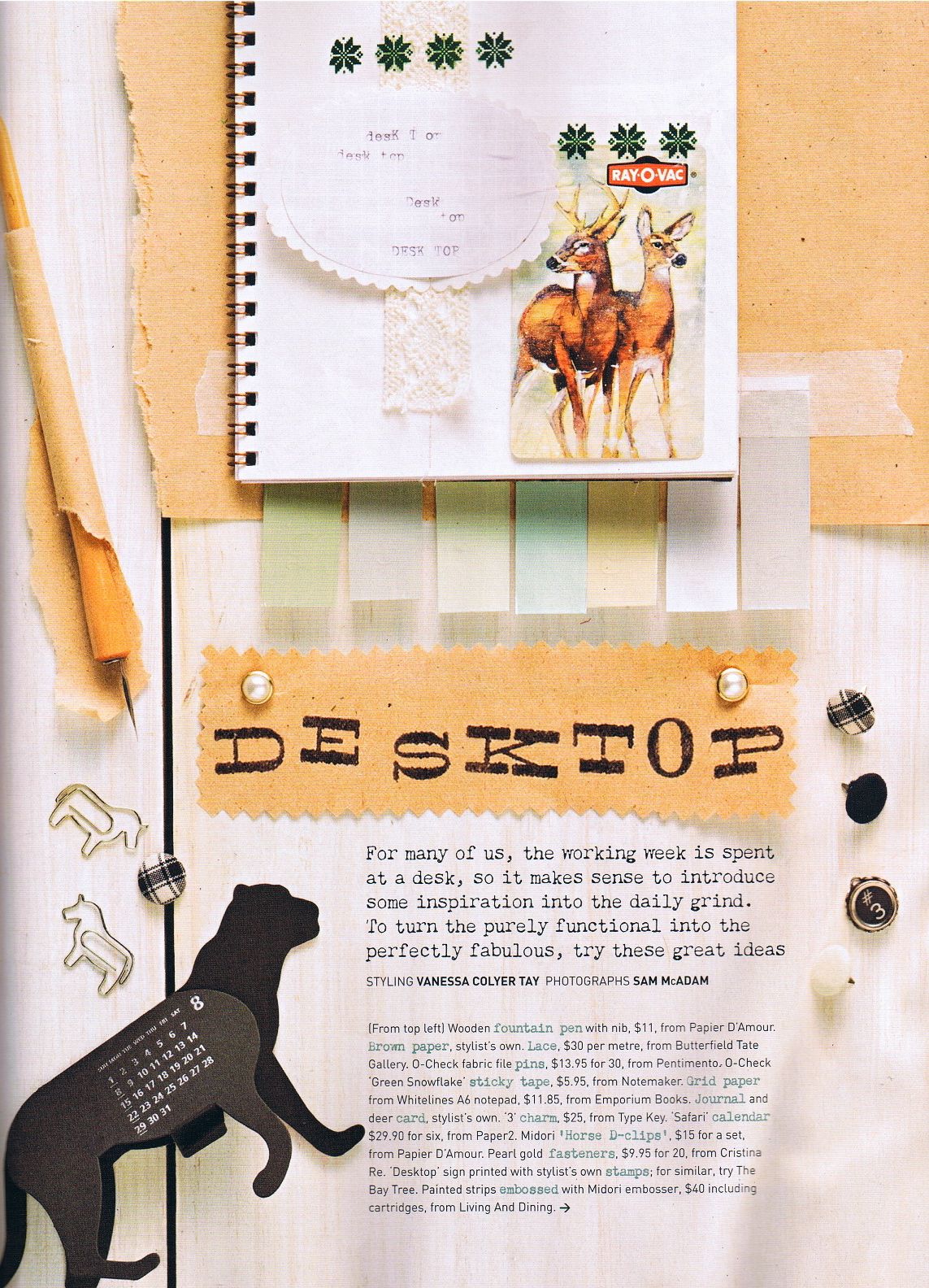
- 'Desktop', styled by Vanessa Colyer Tay – seven pages of work desk ideas. Love, love, love!
- the Love travel guides featured page 180 come in a linen envelope ("smitten from the start");
- the last page, featuring Karen McCartney's top 10 stories from the past decade, more for her insights on what works best in her magazine than the stories themselves.

Of course, McCartney hands the editorial reigns over to Richard Waller in mid-May. What a fantastic legacy to leave behind.

Congratulations to the team!

The magazine is holding an auction of the 36 items that appear in its 'Art Market' spread to raise money for HeartKids. Bookmark the mag's blog here.

Yours truly,
Girl With a Satchel

Girl Talk: Lad mags only part of the problem

Glossy Talk: Lad mags only a part of the problem re. the sexualisation of young girls. Also: Can smart young girls make a difference?

Like so many girls raised in the 80s, it was Judy Blume's Are You There God? It's Me, Margaret – borrowed numerous times from the library and read beneath bed covers – that introduced me to the concept of boobs, periods, bras and Playboy.

When Margaret moves to New Jersey, she befriends Nancy Wheeler who, on their first encounter, tells Margaret, "In a few years I'm going to look like one of those girls in Playboy." Nancy is in the habit of practising kissing, applying lipstick and reveals that "all boys of fourteen are... only interested in two things – pictures of naked girls and dirty books!".

Nancy educates Margaret in what to wear ("wear loafers but no socks"), and the now-famous way to increase one's bust size:

"If you ever want to get out of those baby bras you have to exercise," she told us.
"What kind of exercise?" Gretchen asked.
"Like this," Nancy said. She made fists, bent her arms at the elbow and moved them back and forth sticking her chest way out. She said, "I must – I must – I must increase my bust... We copied her movements and chanted with her. "We must – we must – we must increase our bust!"

At one afternoon meeting of the 'Pre-Teen Sensations', the group headed by Nancy, Margaret is persuaded to find her father's Playboy magazine: "I mean, if it was so wrong, my father shouldn't get it at all, right?", reasons Margaret. The girl in the middle of the magazine is eighteen and has "huge" breasts: "She looks out of proportion!" observes Margaret before the Pre-Teen Sensations finish up with 50 rounds of bust exercises (in stark contrast to what the Baby-Sitter's Club girls were doing with their time!).

After Margaret has an encounter with Philip Leroy during a game of Two Minutes in the Closet, the sixth-grade girls watch a film on menstruation called What Every Girl Should Know "brought to you courtesy of the Private Lady Company". Margaret's not buying in: "The booklet recommended that we use Private Lady sanitary supplies. It was like one big commercial. I made a mental note never to buy Private Lady things when and if I ever needed them."

Who would have thought that insecure Margaret, with her desperation to get her period and bigger boobs, would have been so savvy and cynical about advertising messages... and yet so detached about what she saw in Playboy ("objectification" was clearly not part of her 12-year-old vocabulary)? The book was first published in 1978 – I wonder if a 32-year-old Margaret would deem that Playboy encounter as a turning point in the construction of her self-image?

This week's Aussie media buzz around the campaign designed to get adult magazines and soft porn material out of the eyesight of children, backed by an esteemed group of signatories, argues that the publications are contributing to the sexualisation of children. The group sees the lad mags and porn titles as part of a broader cultural problem in which society is all too relaxed about the exposure of children to messages and images deemed suitable only for adults.

"The lads' mags are part of the whole problem, contributing to the wallpapering of the public domain with hypersexualised images," says author and women's rights advocate Melinda Tankard Reist. "I do believe they contribute to the sexualisation of children."

In response, Australia's biggest magazine publisher ACP, which is responsible for Ralph, FHM, Zoo, The Picture and People, has acknowledged stricter enforcement measures might need to be implemented, though sees no need for a ban. PBL Media's Scott Briggs, who oversees regulatory affairs for ACP, has also denied the use of younger looking models and pointed to the proliferation of porn on the internet, while the "religious right" has come under attack from Australian Penthouse.

It's a contentious issue that's really snowballing in the media sphere right now, as the Hey Dad child sex abuse revelations and Lara Bingle photo scandal linger in the back of our collective memories. Atrocities against women are prolific in the Aussie public sphere. How did we get here? Or did we never really progress past those oppressive, shag-in-the-wagon scenes depicted in films like Puberty Blues?

From where I'm sitting, the lad mags, whose influence is undeniably dwindling (as discussed by Nik Howe at mUmbrella today), are only a part of the problem. Video clips, advertising, radio ads for erectile dysfunction, fashion's obsession with youth, marketing to tween girls and boys, Suri Cruise in $500 shoes, Lady Gaga on her telephone, former High-5 members on the cover of Ralph, 13-year-old girls being violent and foul-mouthed in films like Kick-Ass, and the omnipresence of the big scary internet... it's a minefield of sexualised messages out there for parents raising children.

All the research would suggest that premature sexualisation leads to complications in later life. Tankard Reist's most recent book, Getting Real: Challenging the Sexualisation of Girls, presents 15 compelling essays to awaken our consciousness, challenge our thinking and take action in this regard. She has also set up Collective Shout, an agitator group designed to expose advertisers, marketers and media that objectify women and sexualise children to sell products and services.

There’s no doubting that parents and family are the primary influencers in a young girl’s life, but they are competing with a monolithic machine intent on corrupting childhood. How can we change things? This book is a start, particularly Julie Gale’s empowering chapter, ‘One woman’s activism: refusing to be silent’, in which she records the progress she’s been able to make though Kids Free 2B Kids. In another chapter, Tania Andrusiak, author of Adproofing your kids: Raising critical thinkers in a media-saturated world (Finch Publishing, 2009), writes:

"Getting real is going to take courage. It's going to take a collaborative effort to reject a mainstream view that values only one size, one shape, one demure pout... Courage is the spunky eleven-year-old girl who told me how advertisers wanted girls like her to feel inadequate without the brands they sold in girls' magazines – and who hated the way they made her feel as if buying these brands would make her loved, rather than lonely, in the school playground...".

Perhaps the power is in the hands of the Margarets of the world, who should be encouraged to speak up when they think something's just not right – whether in the presence of a body bully like Nancy or the local newsagent who places FHM right next to her Pony Magazine.

Further reading homework! See also:
- Put soft porn out of view: experts
- Call for soft porn curbs rejected
- Girl Talk: Has toddler fashion inspiration gone too far?
- Girl Power in the satchel (Living Dolls by Natasha Walters)
- Get porn out of the corner store (Melinda Tankard Reist)
- Me vs raunch culture. Or not. (Mia Freedman)
- Lost youth: turning young girls into sex symbols (The Guardian)
- Tiny Tots, High Heels
- The Kids Are Taking Over (Playlist)
- CollectiveShout.org

Yours truly,
Girl With a Satchel

Pop: Baby-Sitter's Business

Pop Talk: 10 Things The Baby-Sitter's Club Can Teach Us About Business (c/o #3 The Truth About Stacey)

Way back in the 80s, before the word 'brand' was used in reference to people as well as laundry detergent, the members of Ann M Martin's Baby-Sitters Club practised an entirely different brand of girl-power to Lady Gaga. They were entrepreneurs.

This, as noted by Lara Vanderkam in The Wall Street Journal, taught girls that you could create your own job and emancipate yourself from your parents' (or employer's) pockets, all the while giving back to your local community and making friends. It's a career ethos I've always believed in, but was never conscious of why until now!

At a time when celebrity appears to be the top currency for success, and we're considering the shortfalls of feminism, it's heartening to be reminded that it's possible to beat your own path with a little ingenuity and determination. Re-reading The Truth About Stacey last night, I discovered the founding foursome of Kristy (president), Claudia (VP), Mary Anne (secretary) and Stacey (treasurer) getting their first taste of competition.

I was so impressed with the way the girls handled the situation, I thought I should share some of their tips.
But first, a bit of back-story for non-BSC readers about the Club from Stacey*:

"We've been in business for about two months. Kristy thought up the club, which is why she got to be president. We meet three times a week from five-thirty to six o'clock in Claudia's room (Claudia has a private phone), and our clients call then to line us up as sitters. The reason the club works so well is that with four baby-sitters there at the phone, each person who calls is pretty much guaranteed to get a sitter for whatever time he or she needs. Our clients like that. They say that having to make a whole lot of calls just to line up one sitter is a waste of time. They like us, too. We're good baby-sitters. And we worked hard to get our business going. We printed up fliers and distributed them in mail boxes, and even put an ad in The Stoneybrook News, the voice of Stoneybrook, Connecticut." I love how she refers to the parents as "clients" - so professional!

1. Service your customers
The book opens with the girls debating how they're going to handle the impending birth of a baby to a regular client, who has a son. Kristy wants to ensure that one of the sitters is available to step in to look after Jamie by ensuring that at least one of the girls is available each afternoon ("It will be a special service for her since the Newtons are such good customers").

2. Be proactive in the face of competition
When Claudia's sister shows the girls a flier being distributed by a competitor club (The Baby-Sitters Agency), Kristy whips into action: "I hereby change this meeting of the Baby-sitter's Club to an emergency meeting."

3. Know your competitor; perform a SWAT analysis
The Baby-sitters Agency has one major advantage: they are older and can therefore stay out later. They also have a better promotional flier. When Mary Anne calls the Agency under a pseudonym, she discovers that they commission out jobs to high-school kids and take a cut of their earnings ("We don't offer a range of ages like they do. There are no boys in our club. And we can't stay out past ten, even on the weekends," says Kristy.) But Claudia knows the girls and isn't a fan: "They have smart mouths, they sass the teachers, they hate school, they hang around at the mall."

4. Strategise and put it to the team
Kristy comes up with a list of ways to improve their business, including:
- doing housework at no extra charge
- special deals for the best customers
- creating Kid-Kits to take to appointments filled with kid-friendly projects, toys and things ("we'll be like a walking toy store")
- lower rates
- take on late jobs and give them to older kids

5. Don't compromise your brand values; your staff want to believe in something
Claudia is defiant: "The Kid-Kit is a good idea, but lower rates and housework and giving away our jobs? No, no, no. If that's what this club is going to become, then I don't want to be in it." The girls resolve to implement the Kid-Kit and special deals, but use Kristy's other ideas only as a last resort. The girls are motivated to work on their Kid-Kits.

6. Focus on building customer relationships
While the Agency starts handing out red helium balloons in public, the Club girls focus on one-on-one time with their young charges. Stacey takes little Charlotte on an excursion and hosts a Big Brother Party for Jamie. The parents are happy because the kids are happy. "A good baby-sitter spends time with the children she sits for," says Stacey. "She doesn't ignore them or talk on the phone or just watch TV all the time."

7. Don't play lowest-common-denominator tactics
Kristy is incensed by the Agency's latest recruitment drive - setting up a stall in the middle school – so she enlists two former Agency girls to work on her staff, only the girls' loyalty hasn't shifted. She is royally annoyed after the new girls fail to show up to their appointments and faces the wrath of the parents for her poor character judgement. Lesson learnt: vet your staff and don't lower yourself with last-ditch tactics that always backfire.

8. Know your clientele
Got to hand it to the Club girls for knowing the particulars of the children they care for: allergies, favourite foods and TV programs, changes in mood. This attention to detail gives them the edge.

9. Respect opinions but focus on one goal
Though the girls have differing ideas and personalities (Claudia is often the first to disagree with Kristy), they're all working together towards the same goal: providing quality sitting for parents and their kids. "We're all different, but our differences work together to bring out the best in each of us... which, of course, helps make us good babysitters," says Kristy.

10. Anticipate the market
By the end of the book, the girls are starting to generate regular business again, but this is no time to rest on their laurels. "With Christmas so close, everybody is going to parties, dinners, concerts... This may be our busiest season," says Kristy. Smarty pants.

In the end the girls learn that all the fancy fliers, clever slogans and recruitment drives aren't enough to sustain a business lacking in integrity. "It's been tough but we hung in there and beat out the agency," says Stacey. "More important," adds Kristy. "We beat them because we're good baby-sitters." Now that's a lesson a few grown-up businesspeople could do to learn.

Yours truly,
Girl With a Satchel

Mags: Seventeen magazine editor Ann Shoket talks shop with Media Bistro

Glossy Talk: Is "Seventeen everywhere" a good thing for girls?

Recently Seventeen magazine editor-in-chief Anna Shoket (pictured) appeared on Media Bistro's Media Beat show, giving some great insights into the magazine's brand strategy.

Formerly the executive editor of the now-defunct CosmoGirl (another Atoosa project), Shoket succeeded Atoosa Rubenstein in 2007, but her main beat has been online – and, more particularly, online innovation. In 2007 she told The Huffington Post that by the time they were three years old her readers had the internet, making a "deeply and profoundly interactive" online presence essential. She also spoke of young girls' "designer lust" for shiny new things, being "dialed to the realities of teen life" and channelling her inner sixteen-year-old. She described the editorial ethos of Seventeen as thus:

"[T]here are the days when you want to call up your most fun friend, and get in the car and go to the mall and drink caramel frappuccinos and meet boys and have a little retail therapy, go shopping and have that kind of crazy fun afternoon. That to me is Seventeen...we have such a fun hyper great energy. My take is that I want to be her best friend. I want to be her most fun friend. We're such a strong fashion and beauty magazine, and that's where the fun comes in. Shopping is fun. Beauty is fun."

She also talked of her responsibility to her readers: "I feel a tremendous responsibility to help these girls grow up to be smart, amazing, self-actualized, fulfilled women. And you know that responsibility is, like, every day. What do these girls need now, so they can walk into any situation and feel confident?"

And then she recalled how Seventeen had "told me I'm the kind of girl that could go out with two guys at once", which set her up for a major social faux pas. Ergo: magazines are flawed. But, while magazines were influential back then, the major difference between the Seventeen (and Dolly, Girlfriend, CosmoGirl...) women like Shoket and myself read way back when and the Seventeen of today is its absolute and deliberate omnipresence in girls' lives. Take a look at a clip...


The context: So, we know Shoket is talking shop with Media Beat and that she does care for her readers. But is the idea of the pretty, perfect, fashion-and-beauty-obsessed Seventeen magazine being "everywhere" in teen girls' lives a good thing? Or just good for sales (obviously a top concern for Shoket)?

The quotes: "I have a philosophy - "Seventeen everywhere". How do we go and create content wherever and whenever our girls are? And so, the web is our partner; we are so deeply integrated as a magazine, as a brand, that we are the number one teen magazine, we are the number one teen magazine website. But not only on the places that we own – Seventeen.com and Seventeen magazine - but we have a huge Facebook presence (that's where our girls are), MySpace, Twitter, YouTube... Teenage girls are the biggest growing demographic of iPhone and iPod Touch users, so we launched an iPhone app. But all of this is everyone swimming together; all the pieces are working in a fantastic, seamless circle to drive readership to the magazine, to the brand, to keep the brand vital."

And... "TV is obviously a fantastic partner for magazines – we're a great partner for America's Next Top Model and they are a really great partner for us. It's really fun, it's a new way to reinforce the brand in a place that our girls - our girls love, so its the perfect place for our brand to be... There's no doubt that it's good for magazines to be part of a good show or to be part of a show that their readers are, like, obsessed with."

The GWAS comment: With all this techno-crowding, I can't imagine girls have a lot of spare time on their hands to just sit and be themselves. I, for one, was overly influenced by the presence of teen glossies that told me I would be happier if I just blasted my pimples, tightened my abs and made a move on the boy I liked. Always the late bloomer, I only got in tune with my "real identity" in my late 20s. And that was without being attached intravenous-like to my iPod/iPhone.

Girls with more solid home lives, and a strong sense of self-worth and familial identity, might be able to better cope with the constant stream of media messages via their techno gadgets without subsuming their values, interests and self-esteem, but I really feel that in this new-media environment – coupled with the increasing pressures on girls and the consequent rise in mental health disorders like anxiety and depression – magazines like Seventeen should be thinking more about the messages they're sending ("Perfect Hair!"; "Look Pretty!"; "Best Butt") than the medium. With growing influence, there simply has to be more social responsibility.

Yours truly,
Girl With a Satchel

GWAS: The Clippings Post


This week's clipping is something from the web I'll be printing out to keep in a scrapbook – because it's deserving of a paper base (sorry, environment); not a cursory bookmark.

Writing for The Boot, folk singer Jewel opens up about her struggles with her self-image, the cruelty she endured as a naive young woman entering the entertainment world, coming under media scrutiny (she was cast as "Renée Zellweger's fat doppelganger"), and a life-defining decision to adopt the motto 'Do No Harm'.

Her strength, determination and resilience are the stuff that great folk songs are made of. Speaking of which (cue promotional segue)... Laura Marling's new album, I Speak Because I Can, is out today.

The former Noah and the Whale vocalist, who looks as disarmingly sweet as Alison Ashley, packs 10 feisty, don't-mess-with-me tracks into her second solo offering, which has all the drama and lyricism of a Robert Browning poem infused with Fiona Apple intensity.

In songs like "Goodbye England (Covered in Snow)", she evokes a feminist resolve (“I tried to be a girl who likes to be used/I’m too good for that/There is a mind under this hat”) accompanied by violins. She has said this album is about "responsibility, particularly the responsibility of womanhood" and, though just 20 years old, Marling demonstrates a wordly maturity beyond the brooding of Avril Lavigne, snark of Lily Allen and wistfulness of Taylor Swift, though her melancholy may find you wishing for something lighter and brighter to chase the blues away.

WIN! I have five copies of I Speak Because I Can to giveaway. To win an album, email satchelgirl@gmail.com with your mailing address and answer to this question: What is the ultimate break-up song?

Yours truly,
Girl With a Satchel

Girl Talk: Has toddler fashion inspiration gone too far?

Girl Talk - Carrie, Tutus and Suri Shoesday
As I was foraging through my wardrobe for shoes to match my denim-skirt-and-blazer ensemble one recent Tuesday, I reached towards my silver peep-toes and thought of Suri Cruise. Not 30-something Carrie Bradshaw, but a three-year-old. Such was the subliminal effect of the Suri-obsessed glossip media, a three year old had managed to enter my mind's repertoire of fashion muses... along with Lady Gaga and Carrie Bradshaw. I dubbed that day 'Suri Shoesday' and vowed to never think of it again... until I read about US Weekly's latest issue, featuring Ferragamo-loving Suri and her tomboy counterpart Shiloh on the cover.

Perhaps it is a natural progression from the celebrity yummy-mummy trend, and the consumer and publishing world's response to said trend, but our preoccupation with tiny tots has spawned a fashion subculture that borders on profane. Take, for instance, the oohing-and-ahhing over the Paris Vogue "Enfants" supplement doing the rounds on fashion blogs (like this), accompanied by text such as "feast your eyes on this" wedged between posts showing smoking models, Lara Stone's buxom body and discussions of photographer Terry Richardson's ethics. Get your kids with your kink!

By the same token, the Enfants
supplement comes with an issue showcasing Paris Vogue's usual edgy, sexy fashion editorials. Carine Roitfeld's styling often incorporates bare breasts, cigarettes and erotic elements (she talked about her ease with such things with The Telegraph). I can appreciate that culturally the French do things differently (the Gauls are geared for sex) and that this supplement is a treat for readers who are mothers, aunts, etc.

Still, there's something disconcerting about the Enfants fashion editorial: perhaps it is that these little girls appear to be brooding in their ballet poses and pointe shoes; looking pensive rather than playful in the moody lighting. Or that they look like mini Charlotte Gainsbourgs or RUSSH magazine models? Or is it just that I can see these ensembles being sported by the girls (and women) who once looked to the likes of Carrie Bradshaw
for fashion inspiration?

In the March edition of Cosmopolitan Australia, editor Bronwyn McCahon confessed to requesting a fringe like Suri Cruise's at the hairdressers, while in the April edition of Vogue Australia, mother and journalist Kerrie Davies writes in 'In My Shoes': "With the tandem advent of eternal youth and ageless style there's no longer such a defined difference between a mother and a daughter's wardrobe."

Davies goes on to cite marketing expert Amanda Stevens, who says mother-and-daughter teams are being dubbed the "four-legged consumer" and author Deborah Tannen who says clothes swapping between mum and daughter is "partly a confirmation of their intimacy, but more than that, mothers think: 'Hmm, I can fit into her clothes. I look youthful, I feel youthful. This is valued in our society... ".

It's one thing to covet Demi Moore's youthful looks and swap cherished pieces between mother and daughter, but another entirely to fawn over a fashion spread featuring a 10-year-old in the context of a grown-up fashion blog or edgy fashion magazine. Channeling the Zeitgeist or childhood exploitation in a consumer driven culture? I'd personally prefer to be "referencing" a grown-up Carrie Bradshaw than a tiny tot in a tutu when I get dressed for the day.

See also:
- Tiny Tots, High Heels
- The Kids Are Taking Over (Playlist)
- Kids are a visual extension of their parents. True or fales? @ Mamamia

Yours truly,
Girl With a Satchel

Mags: Retro Review - Cleo 70s style

Retro Glossy Review

When the first edition of CLEO hit Aussie newsstands in 1972, riding the momentum of the women's liberation movement, it sold out within 48 hours, climaxing (no pun intended) with sales of 250,000 copies five years later. It now sells 128,000 copies a month.

Earlier this week, the magazine's founding
editor, Ita Buttrose, talked to ABC Radio's Richard Fidler about the success of CLEO, amongst other things, which was based on appealing to what she called the "progressive woman".

"We saw the progressive woman as, well, someone like me, from middle-class Australia," she said. "Women's Liberation caught on in Australia because it was middle-class women who embraced it wholeheartedly and CLEO reached that middle-class woman... What [Germaine Greer] did was make us question where we were at; made us realise that perhaps there were other things a woman could do with her life."

And it was CLEO's role to show her just what she could do with her life and the money she made while living it. Perhaps this is part of the reason why mainstream women's magazines like CLEO are struggling now – young women don't feel like there's a fight to be fought; a cause to rally to; a reason to pull together... other than to lay into Lara Bingle?

While the language might be different ("spiv", "sired", "slimmer", "spinsters"), the ads reek of sexism (though, apparently, some parts of the ad world are still lagging behind the publishing Zeitgeist), tanning had no health consequences, sexual liberation was new territory to be explored and "celebrity", as we know it, was yet to be commodified, it turns out the content and stories in CLEO are still much the same (save for the male centrefold!).

Yes, we're still talking about the same things we were 40 years ago: sex, finding good men, singledom, marriage, breast cancer, dieting, cola calories, obesity, alternative medicine, hair colouring, the appeal of the Best Gay Friend and negotiating social situations with aplomb. Travel, astrology, fashion, music, films, books... it was all there to start with and still is.

However, the CLEO of 1974 exudes a certain sophistication and maturity (without the benefit of What We Know Now) that is Very Ita: confident, worldly, provocative, educated; a little lofty. The stories are written for grown-up girls with a flourishing interest in politics and the world outside the shops. Not for this magazine fluffy profile pieces, flimsy reviews or weak vocabulary.

There is always a tendency to glorify the 'grand old days' at the expense of negating the good that is being done now. The CLEO of 2010 is very much of its time. But worryingly, 40 years on, women are collectively still experiencing the same insecurities, self-doubts and decision making scenarios that first presented themselves when 'Liberation' entered the lexicon. But where the CLEO of yesteryear presents us with pages of information to churn over, the CLEO of now is more positively intent on helping us cut to the chase and win the race on our own terms.

Still, perhaps a little historical exploration will encourage us all to lift our game (as apposed to a middle finger) in all the areas where the Liberationists left off?

CLEO, February 1974, 60c, ACP Magazines
Editor: Ita Buttrose
The cover:
Model Louise Francett, shot by Carroll Holloway, wears a Carla Zampatti dress and cosmetics by Yardley.
Editor's letter: Buttrose highlights two new regular features – stories "designed for those of us who have children" and a diamond ring offer ("we have eight styles for you to choose from") – as well as the triple gatefold centrefold ("we had to fit in 16 men"), astrology special ("I always like to read my stars each morning"), and main cover feature, "The Female Woman" (huh?).

Main features: "The Female Woman" is a three-page extract from Arianna Huffington's (nee Stassinopoulos) book of the same name, which was her anti-feminism treatise. In short, she respects the idea of female emancipation but not the "repulsive" Women's Liberation Movement ("a doctrine of mass egotism"), which she says negates and devalues distinctively female qualities, attitudes and values: "Emancipation insists on equal status for distinctively female roles...it does not mean compelling women into male roles by devaluing female ones. It means adults choosing freely the way they run their own lives."

She takes the Libbers to task for rejecting the "otherness" of men; for showing "unliberated" women contempt; for defining men as the enemy; for its rejection of altruism, virtue and sacrifice; for idealising institutionalised work outside the home; for fostering insecurity through the blurring of male and female expectations of behaviour; and for denying intelligence and femininity are compatible. Her contempt for her Liberationist contemporaries is seething but many of her arguments are inconclusive: the conversation continues.

Other features:
- 'Tricia Edgar and the words of change' - while academics are often cited in CLEO stories today, it would be an unusual thing to see a five-page profile feature dedicated to one, which is a shame, as so many dynamic, interesting women exist in the field. Tricia Edgar – author, academic, mother, champion of women's rights – is fascinating, if intimidating. A real powerhouse, she has three books to her credit at the time of writing: one which looked at how growing up was limiting for girls; another on the exploitation of women through mass media and advertising; and a third dealing with children's perceptions of violence in film.

Her comments on women's media are equally as relevant today: "The idealised woman in the mass media is the same the world over. She is young, essentially youthful, with a slim figure. She is all things to all people... a mother to her kids, a wife to her husband, competent in her work role. This tends to confuse women – particularly in Australian society – about which role they should be filling... there are a hell of a lot of women caught in a state of ambiguity, not knowing quite how to behave... and this is where women's magazines and newspapers can help them..."

And on the media reflecting and reinforcing attitudes and type-casting: "The publishers are caught. Their public doesn't know what it wants, they aren't sure what to offer. Inevitably they proceed with caution, take things gradually. The main exception is that American magazine, Ms. That was a gamble. Ms didn't know whether there really was an audience waiting for its Women's Lib-oriented ideas but it went ahead... and sold out... Maybe our women's magazines could be one hell of a lot more adventurous. I wish they would be, personally.

I believe – and I will say so in my book – that while some of our magazines do publish good individual articles, mostly their whole orientation is a put-on. They tend to push sexual liberation, which can be much more confusing than beneficial, although I think it's very good that women can now talk about their sexual experiences and what any of the inadequacies might have been. The magazines come on in the guise of attempting to do something for Women's Lib while in fact they're reinforcing the same old stereotypes, offering a more sophisticated way to get your man. I don't think that's what it's all about. I wish they could go further." Words out of mouth.

- Supporting Edgar's argument this issue is, amongst other stories, 'These days a good man is hard to find', which reminds me of the episode of Sex and the City where Carrie is commissioned to give a lecture on this very topic. The writer, Annette Morris, classifies a "good man" as someone one who will tell you he adores you at least twice a day and who has an interesting job: "One which will keep him employed happily long enough for you to have your hair, face and nails done... providing enough money for you to splash on a new outfit at least once a week." She advises you against "peacock types" (insecure and frivolous), hippies, university-educated snobs and "men who wear red shirts with pink trousers" and, should you find a potential candidate, sit next to him while he's eating an apple and ask if you can put up with the noise. Her last words: "good luck".

- 'The Woman Alone' is author Patricia O'Brien's third-person exploration of what it means to be a woman without a man in a society that grooms girls on the "unspoken assumption" that she will marry. The piece is accompanied by an illustration of a woman with her face downcast. O'Brien asserts that "very few women actually choose singleness" and paints a rather morbid picture of the women plan their days meticulously to circumvent lonely situations, are burdened by choices and "look ahead only to short-range goals: a university degree, a new job, going out on Friday nights." Far from the glossy set of Sex and the City, a new type of single woman has emerged who has "built something separate for herself that depends on no man and is "wary of fashioning herself to please the first man who demonstrates interest and affection" but who ultimately wants to "fulfill the yearning for someone to love truly, deeply, permanently" - preferably before she gets too old ("the ultimate nothingness"). Though there's a cursory nod to "the troubled self-questioning of wives" who live their lives through their husbands, there is no suggestion that one can feel utterly alone in marriage, too. Depressed? "Weave yourself a cushion!".

- The now-late Minister for Immigration Al Grassby (dubbed the "father of multiculturalism") is pitched to CLEO readers as a very good man. The colourful, affable politician responsible for "felling the White Australia Policy" is an unstoppable force who is given several column inches to impress us with accomplishments and encyclopedic knowledge of Australian history. His Utopian vision for a better country was his motivation: "If you have a program of things you want to do, then the inspiration is to see them getting done... That's why you've got to be in it – certainly not just to sit in an office and look important." He believed the "highest calling for a man is in public life" and certainly lived his life as if it were.

Other features:
- 'Genetics: humans made to order'
- 'Mastectomy: new approaches to rehabilitation'
- 'Male stripping: art or just another rip-off?
- 'CLEO's Men of the Month' centrefold showcases 16 members of the 17-member Daly-Wilson Big Band in the buff. Toot-toot.
- 'The CLEO Guide to Astro-Analysis'
- 'How to renovate and survive'
- 'At home with Anne and Jan Raaymakers'

Main fashion: In 'Tweed, checks and other flecks', "the country look comes to town"... as it has again, in 2010! Shot by John Porter in a ballet studio, the models play ballet mistresses.
Beauty: "Multi-shading is a new colouring technique by Schwarzkopf for re-creating those natural, child-like hair lights."
Health and diet advice: "For those who have weight problems, alcoholic drinks are not good news" - Rosemary Stanton; imagine that piece of chocolate cake is "a huge lump of faeces dripping with thick phlegm". Ew.
Entertainment: Reviews take in The Canterbury Tales.
Advertisements: Yardley Power Eyeshades; Uncle Sam Anti-Perspirant Deodorant; Check deodorant toothpaste; Johnson's Baby Oil ("Stay baby soft all summer through, baby"); Gilbey's Gin; Kodak; Iceberg cologne; Benson & Hedges; Enavite; P&O; Stayfree...

Yours truly,
Girl With a Satchel

GWAS Bloke In Media - Bruce Daly, art director

Last November Good Weekend magazine celebrated its 25th anniversary, producing a spectacular cover designed by Bruce Daly in addition to an editor's retrospective. Daly has since parted company with the prestigious Fairfax newspaper supplement, but today adds a bit of bloke to GWAS with insight into the art director's role, the influence of punk culture and pop art and his most memorable Good Weekend covers...

Good Weekend is a pillar publication in Australia. What was your art direction on the magazine? I've had two stints on Good Weekend. The first time was for about nine months in 1989; time enough to reduce the number of typefaces and colours being used. The second time was in 1997, which was a proper relaunch of the title with Fenella Souter, the editor, who I had been working with at HQ magazine.

The magazine changed in size from A4 on coated stock to the large, 355mm X 278mm newsprint version we have today. Fenella's vision for the magazine was for a more journalism driven title sterring away from too much reliance on lifestyle content. It was a larger magazine in terms of pages also, with page counts up around 70 to 100 pages.

In terms of design, my job was to showcase the excellent journalism and give the publication authority and gravitas. At the time we were looking at the UK supplements in The Guardian and The Independent and, to a lesser extent, The New York Times Magazine.

In terms of cover subjects, GW continues to push boundaries. Is this a benefit of not having the typical concerns of generating newsstand sales? Newsstand mags have a lot of design constraints when it comes to covers. Big, readable mastheads and coverlines are the commercial reality and often a recognisable celebrity. I think there's a lot more freedom with an insert mag about what you do with the cover. Unfortunately, in the last few years, even insert mags have started to use cover formulas that are meant to reinforce the brand and the recognition of that brand, which is a bit sad. And a little boring.

What were your most memorable Good Weekend covers? Did any garner a particularly controversial response or traverse new territory? There were a lot of covers! But here are some that stood out for a variety of reasons...

October 4, 2008: "This was a controversial cover about a controversial artist, Bill Henson. The decision to run the naked shot (very small) was brave but necessary inside the mag." January 31, 1998: "Originally I wanted a pic of a patient in an induced coma. Unfortunately the reality was considered too grim as it involved a breathing tube. This was the compromise."

June 18, 2005: "The Design issues of Good Weekend gave me the chance to try more abstract ideas." March 23, 2002: "This was another difficult topic which has to be treated with sensitivity. I backgrounded the horrific shot of the anorexic girl to make the cover acceptable to a wide audience."

May 8, 2004: "This was the first (and only) time the name of the mag appeared sideways. I argued that as the mag was an insert we could break some rules. The shot too was a concern as it pushed right up to the "yuck" limit. Personally, I liked how I aligned the type using the scar." November 7, 1998: "This was a minimalist cover for the Y2K bug/disaster that never eventuated. This sort of imagery is possible when the magazine doesn't need to work off a news stand. Unfortunately a lot of editors slavishly follow the conventions of news stand titles without really thinking about how the mag is read."

June 19, 1999: "This was something I shot with Richard Ludbrook. I'm particularly proud of my headline and the subtle dig at wallpaper magazine. Humour doesn't get used on magazine covers much anymore, I'm not sure why." July 3, 2004: "The use of toy food worked really well for this."

May 19, 2001: "This illustrated cover I commissioned from Glenn Lumsden annoyed a lot of American readers. I've included here because I love the illustration and it's an example of an "issue" based cover that is becoming increasingly rare in Australia." September 6, 1997: "This was a lovely upbeat shot of Francis O'Connor, by James Braund, at the beginning of her career which I art directed and commissioned."

November 12, 2005: "We ran this before Chris Lilley was as well known as he is now. We had letters from people asking us why this "girl" thought she was so hot!" November 4, 2006: "This was something that worked well graphically."

April 6, 2002: "This cover got a lot of attention (including Mediawatch on the ABC)". February 11, 2006: "In the time I've been working on magazines stock photography has gone from being the last resort to often the first choice for art directors."

In your view, does Australia play it safer in terms of magazine design? Sadly, yes. Most of the magazine design here is based on work done overseas. That is also due to many mags here being franchises from OS.

Are there any Aussie titles doing exceptionally good design work? I think The Financial Review Magazine stands really proud in the newspaper insert category. Australian GQ magazine is also very well done.

On the global scene, are there any covers that stand out in memory? I wouldn't know where to begin! I think I could best answer that by mentioning some of the truly exceptional magazine art directors whose work I have admired. In no particular order:
- Alexi Brodovitch (Harper's Bazaar) http://www.iconofgraphics.com/Alexey-Brodovitch/
- George Lois (Esquire) http://georgelois.com/esquire.html
- Neville Brody (The Face, Arena) http://www.researchstudios.com/neville-brody/
- Janet Froelich, Creative Director, The New York Times Magazine)
- Fred Woodward, (ex Rolling Stone, now US GQ creative director)
- Roger Black (he's everywhere!)

What is the key to being a good art director? Forming a relationship of mutual respect with the editor/publisher is crucial. I've been fortunate to have worked with some truly amazing editors: Shona Martyn at both Good Weekend and then ACP's HQ, and Fenella Souter (also at HQ and then back at Good Weekend!).

This relationship, at its best, is a great creative partnership where the art director realises the editor's vision. A good art director, I believe, also needs to read – it's especially important when working in the conceptual realm of being able to convey a story's main idea through arresting visual imagery and type. An art director doesn't work in isolation, so having great subs and production teams also make a better mag.

Where does your passion for design and art come from? I sort of fell into it from an early age. I won a scholarship when I was 12 to a Special Art high school. People kept telling me I was good at it, so I stuck with it. I did a BA in Design at what is now Curtin University in Perth, WA. I majored in photography and graphic design. I was there from 1979 till '81.

After graduating I spent a year working for the Student Guild at the University of WA producing also sorts of stuff, including the student newspaper, Pelican. I was pretty much left alone to figure out the technical and artistic side of things, which was pretty daunting, but also exciting and creatively very liberating.

Who/what have been the key influences in your career? Before I studied design I was unsure about what I wanted to do. I got into a degree in Economics at the University of Western Australia, but I decided to take a year off and ended up working for an insurance company, where I was very bored.

When the Punk thing happened in Perth in '77-78, I started going to a lot gigs and came into contact with the whole art-school crowd in Perth. They all seemed to be having a great time and it was something I really wanted to be part of. There was an enormous explosion of energy and ideas around that post-punk scene. I decided to go to art school instead, which kind of made sense having won the scholarship to the art high school. I was initially accepted as a Fine Art student. The lecturers tried to encourage me based on my drawing portfolio, but I didn't really have the confidence to take on something that wasn't going to lead to a job.

I loved the whole anti-art aesthetic of Pop Art, so I gravitated to graphic design. Like a lot of young designers at the time, I was following pretty much everything Neville Brody was doing on the Face magazine. I also loved the photography of Anton Corbjin which was appearing in New Musical Express (NME). Also, the work of Malcolm Garrett and Peter Saville in London, who designed – amongst other things – record covers and imagery for Joy Division, Magazine and the Buzzcocks. It was a very cool and minimal style that used a lot of pop elements. These were guys who were in their mid-20s and were changing graphic design; it was pretty exciting.

If you could produce your own magazine, what would it feature and what would it look like? At this point in publishing history, I'm not sure that would be such a good idea. Ideally, I think quality magazines should surprise and intrigue a reader. I think there's way too much reliance on dishing up shiny, bland pages. I'd love to aspire to do something as good as Wired or the NYT Magazine.

Check out more of Bruce's work @ www.brucedaly.com

Yours truly,
Girl With a Satchel

Mags: Lara Bingle, Woman's Day, ACA. #2

Media Study - Lara Bingle, the mute victim

Last night's A Current Affair
report did very little to contradict my suspicions that the whole, sordid Lara Bingle Bungle is a big, fat farce, insulting the Australian public's collective intellect with each highly orchestrated and sickly-slick PR move. Seriously ick.

While I wouldn't deny the importance of discussing the sexism that exists in the world of football, how technology is invading our personal lives or Brendan Fevola's culpability, for me, this story is more about the misuse of media power, the public mistrust that inevitably follows and the commercial interests that drive editorial decisions ahead of ethical considerations.

Someone with even the most basic media literacy skills might have observed that the Woman's Day cover feature is highly stylised – and I'm not just talking about the glamour shots of blue-eyed Bingle by the pool. It would be unsisterly to doubt Bingle's ability to string together an articulate response to Phillip Koch's questions, but, as social commentator and journalist Rachel Hills observes, it "looks like the questions were sent off to the PR and returned via email."

Case in point: "This is anything but a publicity stunt. It has been terribly humiliating for me. This is why I wanted to speak to the same magazine and to the same readers who would have seen the photo and read the article in last week's edition. This is my attempt to reduce the damage caused to me when Brendan circulated the photo."

Oh, puh-leeease!

In the world of celebrity journalism, this is nothing new – PRs often vet or veto glossy interviews to ensure their "talent" is presented in the best possible light. But the notion wasn't exactly dispelled by A Current Affair, either – though we see Koch is present at the photo shoot, and are told he spent "hours" with her, we don't observe him talking to her (oh, look, he's in the blue shirt next to her: they must be chummy!). And all his comments about her don't suggest a familiarity beyond a quick "hi" at the photo shoot. In fact, he looks plain awkward talking about her – like when you haven't prepared for an exam.

My guess? Max Markson replied on Bingle's behalf, pocketing a healthy cut of the reported $200,000 Bingle "allegedly" secured for the Woman's Day exclusive. Another win for PR; another blow for journalism's name. But, really, are we surprised? It's like a big game! No one takes glossip mags or tabloid-style current affairs shows seriously, do they?

Another betrayal was A Current Affair's billing of the Bingle report as an exclusive insight, which suggested she might have been interviewed. Bingle is once again rendered mute – the pretty model muse and innocent victim in the background discussed by media "talking heads" Mia Freedman, Melinda Tankard Reist, Dr Leslie Cannold and Koch himself (all who did add something legitimate to the debate beyond media ethics). Woman's Day editor Fiona Connolly was another notably absent talking head.

What's more, the repeated showing of the "shower shot" throughout the report just further objectified Bingle: she is now The Shower Shot; not a Real Person. How is this doing her a favour? If the ACA piece was orchestrated as a make-good for Markson and co. by the powers-that-be at ACP, then I wouldn't be a happy camper if I were in Bingle's shoes.

With all this embarrassing coverage and blatant kowtowing to Max Markson's interests (which are not necessarily in line with his client's best interests – being elusive is not a good look for a girl who wants the public's sympathy), Woman's Day is going to need a serious PR campaign of its own to win back the respect of readers.

Yours truly,
Girl With a Satchel

GWAS: The Clippings Post

Favourite clippings lovingly gleaned from newspapers, supplements, local press and magazines...

Taking note of The Clippings Post submission requirements – more particularly the point that states "no 6000-word essays from The Monthly" – the political journal took it upon itself to make a submission this week.

"We are tickled by your bar on 6000-word essays from The Monthly for The Clipping Post section. However, we thought Girl With a Satchel might still be interested in a comparatively short 2900-word piece on what is Australian style by Clare Press."

Interest piqued! And any misconceptions that the title's staff is made up of a bunch of crotchety old curmudgeons who bore each other to death with political rhetoric and dad jokes is laid to rest. I'm a sucker for cheek. And equally tickled that the title's young editor, Ben Naparstek (who lifted the title's readership 45.2% last year) had the good sense to commission a piece by Press.

Those who lamented her departure from Vogue Australia, and have enjoyed her "Chictionary" musings on this here blog, will find Press in full, fashionable feature-writing form in "Blankett Slate", an essay investigating the essence - or lack thereof - of Australian style. Press' writing is the pinnacle of Australian fashion journalism – expertly and wittily crafted, but without being stuck up its own bum.

While entertaining, it's not just a fluffy filler piece – description, anecdotes, observation, history, pop culture and media commentary all come into play as Press considers the impact of a little label called Romance Was Born, the influence of Balmain and relates a tête-à-tête with Jenny Kee.

At a time when Harper's BAZAAR has eschewed the long-form fashion essay in favour of shorter trend spiels and Vogue's essays are consistently more explorations of the female condition than how women interact with fashion, The Monthly is all the more appealing for women who like their fashion with some intellectual fortitude; those who are just as likely to be interested in Germaine Greer as Gucci.

I implore you to pick up a copy or read Press' piece online.

How to contribute to The Clippings Post:
1. Scan in your clipping (single page is preferable – no 6000-word essays from The Monthly: we don't want to fall asleep).
2. Email clipping in JPG or PDF format to satchelgirl@gmail.com.
3. Provide credits (publication, date, author/photographer/illustrator/stylist).
4. Explain why you enjoyed the column/story/page layout/illustration/image/styling.
5. Supply mailing address so you can be duly rewarded with a plump new book for your bedside table.
6. Stay tuned to see if your clipping made the cut.

Yours truly,
Girl With a Satchel